
New Protective Eyewear Requirements
New England Lacrosse protective eyewear requirements take effect from 1 September 2026
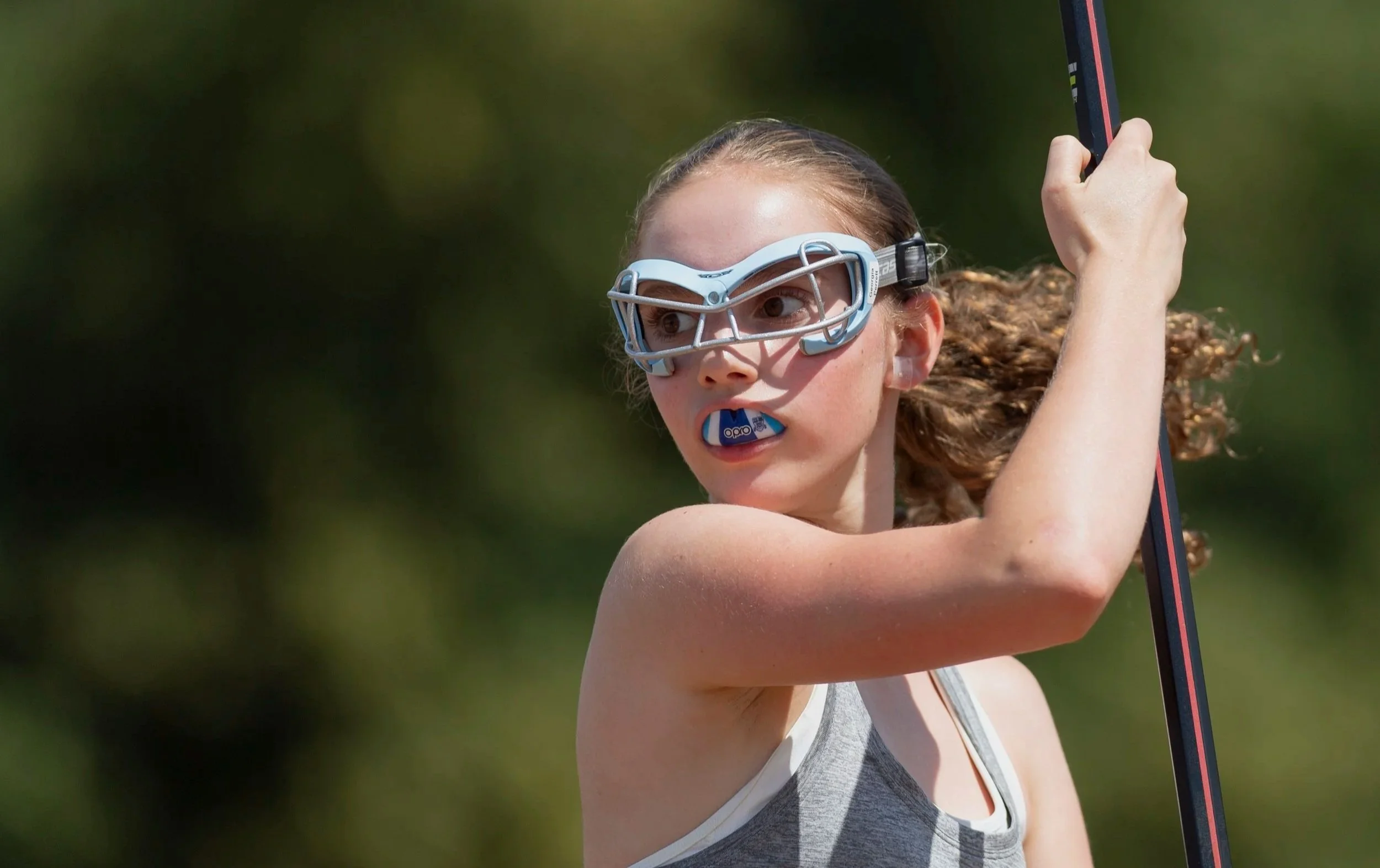
England Lacrosse is introducing new protective eyewear requirements as part of our ongoing commitment to player safety.
From 1 September 2026, protective eyewear will be mandatory for participants taking part in all organised lacrosse activity in England where a non-deformable lacrosse ball is used and the playing rules do not already require a protective helmet with a face mask.
Non-deformable balls include regulation match balls and solid rubber training balls, including low-bounce solid balls, with the new requirements applying across organised activity including matches, competitions, training, and camps.
Existing goalkeeper protective equipment requirements remain unchanged. Where the applicable playing rules require a goalkeeper to wear a protective helmet with a face mask, this must continue to be worn. The new protective eyewear requirement does not replace or reduce existing goalkeeper protection requirements.
Where a deformable ball, as defined in the England Lacrosse Ball Classification Guide, is used, protective eyewear is not mandatory.
What is changing?
From 1 September 2026:
Protective eyewear becomes mandatory
If you are taking part in organised lacrosse activity using a non-deformable lacrosse ball, and your playing rules do not already require a protective helmet with a face mask, you must wear compliant protective eyewear.
This applies whether the non-deformable ball is a regulation match ball or a solid rubber training ball.
Non-deformable lacrosse ball: A solid rubber or similarly hard lacrosse ball that does not noticeably compress or change shape during normal use.
Soft-shell headgear can be worn
Players taking part in lacrosse played under non-contact playing rules may choose to wear compliant soft-shell protective headgear.
Soft-shell headgear is optional and must not replace a protective helmet where a helmet is required by the applicable playing rules.
Which Protective Eyewear Should I Use?
Where protective eyewear is mandatory, players must use protective eyewear that meets the performance requirements recognised by England LacrosseFor most players, this means using lacrosse-specific protective eyewear designed to reduce the risk of serious eye injury from accidental impact by a ball.
What should I look for?
Choose protective eyewear that:
is designed for use in lacrosse;
meets a recognised lacrosse protective eyewear performance standard;
fits securely and comfortably;
does not obstruct vision; and
is maintained and used in line with the manufacturer’s instructions.
England Lacrosse currently recognises eyewear tested to ASTM F3077, or UKCA Certified.
How do I know if my current eyewear is suitable?
Check the product, packaging or manufacturer information for the relevant certification or performance standard.
If you are unsure whether your eyewear meets England Lacrosse requirements, check the England Lacrosse equipment guidance or contact your supplier before taking part.
What does not count?
The following should not be assumed to meet the requirement unless they are specifically certified for lacrosse use:
everyday prescription glasses;
sunglasses;
general sports glasses;
industrial safety glasses; and
untested or non-certified eyewear.
What if I wear prescription glasses?
Players who wear prescription glasses should use a suitable protective eyewear designed to be worn over prescription glasses.
Important
Protective equipment can reduce the risk and severity of injury, but it cannot eliminate all risk. Players should ensure their eyewear is correctly fitted, in good condition and suitable for its intended use.
Existing goalkeeper protective equipment requirements remain unchanged. Where the applicable playing rules require a goalkeeper to wear a protective helmet with a face mask, this must continue to be worn. The new protective eyewear requirement does not replace or reduce existing goalkeeper protection requirements.
What does this mean for different forms of lacrosse?
-
Protective eyewear mandatory when a non-deformable ball is used.
-
Protective eyewear mandatory when a non-deformable ball is used.
-
Protective eyewear mandatory for players not otherwise required to wear a helmet with a face mask when a non-deformable ball is used.
-
Protective eyewear not mandatory.
-
Existing helmet requirements continue to apply.
Do I need protective eyewear?
The simple principle: if you are taking part in organised lacrosse activity using a non-deformable ball and your playing rules do not already require a helmet with a face mask, protective eyewear is mandatory.

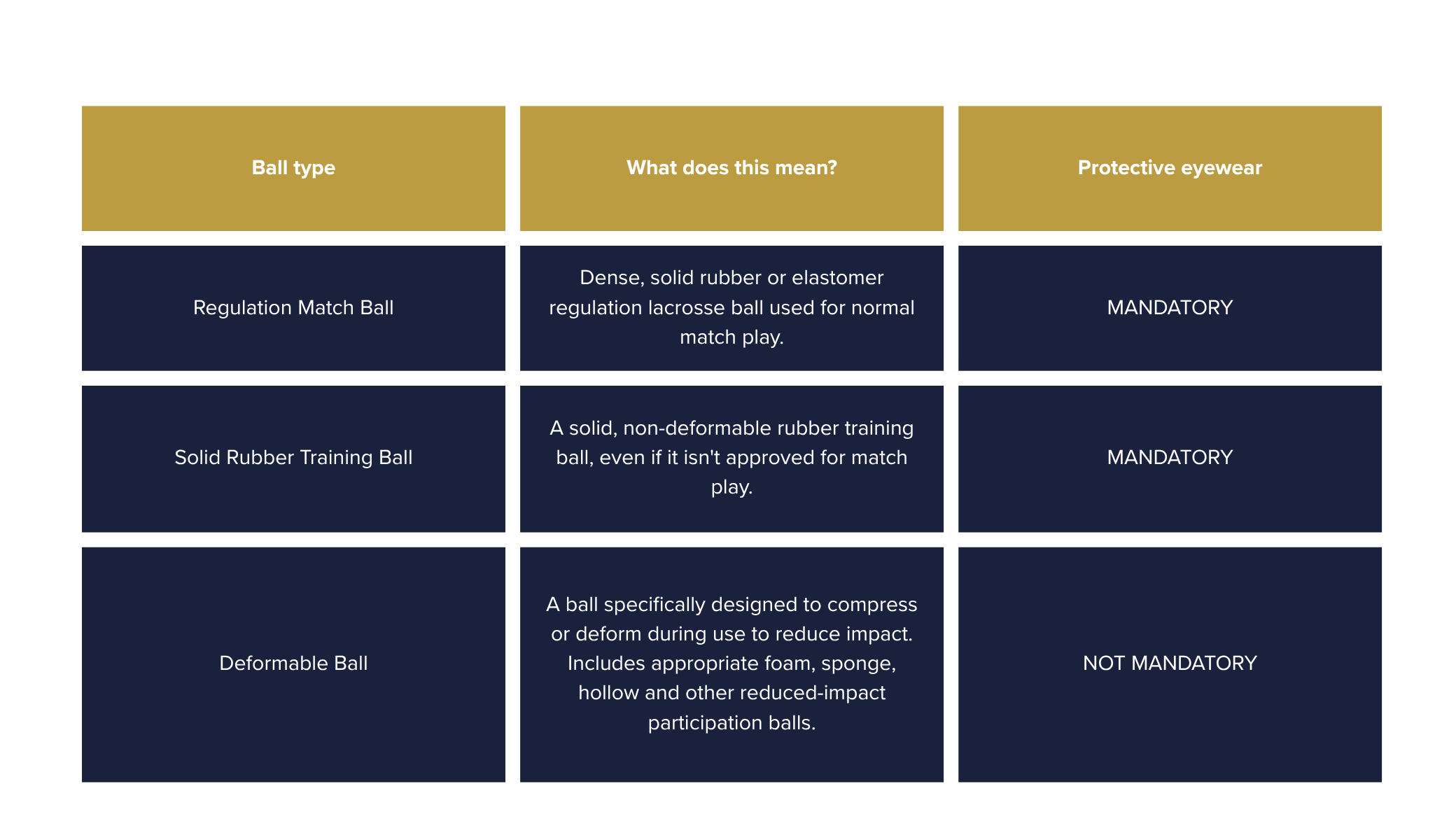
Which ball am I using?
What does this mean for beginners and schools?
You do not need to buy protective eyewear simply to try lacrosse.
Where an introductory or development activity uses an appropriate deformable ball, protective eyewear is not mandatory.
This means schools, clubs and other providers can continue to deliver accessible introductory lacrosse using appropriate deformable equipment.
If a session progresses to using a non-deformable lacrosse ball, protective eyewear must be worn.
Protective Eyewear FAQS
-
Player safety is central to England Lacrosse's approach to the development of the game.
Following World Lacrosse's announcement of new international athlete safety measures, England Lacrosse reviewed the implications for domestic lacrosse in England.
Our approach has been designed to strengthen player protection while remaining proportionate and practical across clubs, schools, universities and other participation environments.
By linking the mandatory eyewear requirement to the type of ball being used, introductory and development activity can continue to use appropriate deformable balls without creating an unnecessary equipment barrier for people starting the sport.
-
Mandatory protective eyewear applies to all participants taking part in organised lacrosse activity in England where a non-deformable lacrosse ball is used and the applicable playing rules do not already require a protective helmet with a face mask.
This includes competitions, matches, training, and camps.
Where a deformable ball, as defined in the England Lacrosse Ball Classification Guide, is used, protective eyewear is not mandatory.
-
The mandatory requirement for all players comes into immediate effect as of 1st September 2026.
-
Protective eyewear is a proactive piece of equipment designed to minimise or significantly reduce injuries to the eyes due to impact from lacrosse balls. Eyewear must comply with ASTM F3077, or another recognised equivalent standard accepted by England Lacrosse.
-
Non-deformable balls include match regulation balls and non-regulation solid rubber training balls, which includes low-bounce solid balls.
The risk factor is the ball type. Non-deformable balls create a significantly higher risk of facial and eye injury.
England Lacrosse will publish a simple grid clarifying scenarios and provide signposting to alternative balls promoted for use in introductory sessions, taster sessions, school PE lessons.
-
Yes, England Lacrosse has the authority to set safety regulations on behalf of the sport nationally and any lacrosse activity whether under the England Lacrosse remit or not, is required to comply with nationally set regulations such as this.
-
Individuals should take personal responsibility to ensure their equipment aligns to the required safety standards, and they are taking precautionary steps to reduce their chance of sustaining injury by wearing protective eyewear whilst partaking in lacrosse.
There is an expectation on officials and coaches as responsible leaders to ensure adherence to the rule across matches and training sessions.
-
England Lacrosse has contacted UK based suppliers to ensure stock availability. Goggles can be sourced from the following retailers:
Northern Soul
Pioneer Lacrosse
Pulse Lacrosse
UK Lacrosse -
No exemptions are permitted to the rule, and all players are required to comply.
-
Players who wear prescription glasses will need approved goggles that fit over or integrate with eyewear these can be purchased from UK based retailers – ‘Unique Sports Over The Glasses Lacrosse Goggles’.
-
No. Hard-shell helmets must not be worn by field players in mixed lacrosse.
Mixed lacrosse is played under non-contact rules and not all participants wear hard-shell protective equipment. Wearing a hard-shell helmet could therefore increase the risk of injury to another player during accidental contact.
Where a non-deformable ball is used, field players must wear compliant protective eyewear.
-
England Lacrosse is exploring partnerships with suppliers and The Lacrosse Foundation to support schools and smaller programmes.
Any members who require financial support should email [email protected] where a member of the team will be able to discuss support options
-
Schools and clubs can contact England Lacrosse for guidance. Regional support or Foundation pathways may be available.
-
Yes. England Lacrosse is preparing to hold a stock of goggles for national programmes to ensure no participant is excluded.
-
Existing goalkeeper protective equipment requirements remain unchanged. Where the applicable playing rules require a goalkeeper to wear a protective helmet with a face mask, this must continue to be worn. The new protective eyewear requirement does not replace or reduce existing goalkeeper protection requirements.
-
If you are participating in lacrosse activity in England or in an England Lacrosse sanctioned league or competition, then yes.
-
All enquiries should be sent to: [email protected]
How to choose the right protective eyewear for you
1. Start with the standard
Before considering colour, style or price, check that the eyewear meets the performance requirements recognised by England Lacrosse.
Look for the relevant performance standard on the product, packaging or manufacturer's product information.
Don't assume that something described as "sports glasses", "safety glasses" or "protective eyewear" is suitable for lacrosse.
2. Find the right fit
Protective eyewear should fit securely and comfortably around your face.
When trying it on, check that:
it sits securely without excessive movement.
it doesn't slip when you move your head.
it doesn't feel excessively tight or create uncomfortable pressure points.
it sits correctly around your eyes and face; and
any straps can be adjusted to provide a secure fit.
If possible, try different models before buying. Face shapes and sizes vary, and a model that fits another player well may not be the best fit for you.
Quick fit test
Put your eyewear on and move your head up, down and side to side.
It should remain securely in position without you needing to continually readjust it.
3. Check your vision
You need to be able to see the game clearly.
When wearing the eyewear, check your:
Forward vision
Can you see comfortably ahead without the frame distracting you?
Peripheral vision
Can you see appropriately to either side?
Downward vision
Can you comfortably see your stick and the ball?
Try looking around as you would during a game rather than simply looking straight ahead in a mirror.
4. Think about comfort
You'll potentially be wearing your eyewear for an entire training session or match, so comfort matters.
Consider:
weight;
pressure around the nose and temples;
ventilation;
how the eyewear feels when running;
whether it stays secure when you sweat; and
whether the fit remains comfortable over a longer period.
A secure fit shouldn't mean an uncomfortable fit.
5. Do you wear prescription glasses?
Everyday prescription glasses should not be assumed to provide the required protection on their own.
If you need vision correction while playing, look for a suitable solution that like protective eyewear designed to fit over prescription glasses.
6. Consider the type of eyewear
Lacrosse protective eyewear is available in different designs, materials, sizes and price points.
The most expensive option isn't automatically the best option for you.
Your priorities should be:
Compliant
Secure
Good visibility
Comfortable
Suitable for you
Once those requirements are satisfied, you can consider factors such as style, colour, weight and price.
7. Try before you buy where possible
If you have the opportunity, trying eyewear on is the best way to understand which model suits you.
Your club, teammates or equipment retailer may be able to help you compare different sizes and designs.
For junior players, remember that fit can change as they grow. Check regularly that their eyewear continues to fit correctly.
8. Already own goggles?
You don't necessarily need to buy a new pair.
Check whether your existing eyewear:
meets an England Lacrosse-recognised performance requirement.
fits correctly.
is free from damage.
has secure straps and fittings; and
remains suitable for use according to the manufacturer's instructions.
If it meets the required standard and remains in suitable condition, it may continue to be used.
9. Look after your eyewear
Before playing, give your eyewear a quick check.
Look for:
damage to the frame.
damaged or missing components.
worn or damaged straps.
loose fittings; and
anything else that could affect its fit or performance.
Follow the manufacturer's instructions for cleaning, storage, maintenance and replacement.
If your eyewear has suffered a significant impact or you are concerned that it may be damaged, follow the manufacturer's guidance and replace it where necessary.
Your Five-Point Check
Before buying or using protective eyewear, ask:
✓ COMPLIANT
Does it meet an England Lacrosse-recognised performance requirement?
✓ FIT
Does it stay securely in place?
✓ VISION
Can I see comfortably in all the directions I need during play?
✓ COMFORT
Can I comfortably wear it throughout a session or match?
✓ CONDITION
Is it undamaged and properly maintained?
If the answer to all five is yes, you're ready to play.
Remember
Protective equipment can reduce the risk and severity of injury, but it cannot eliminate all risk. Correct fit, condition and use are important.